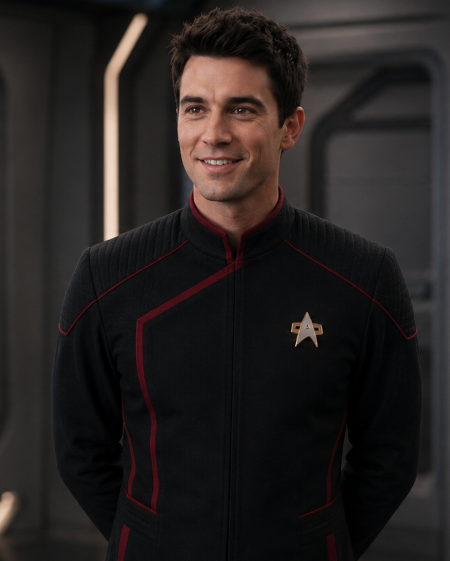
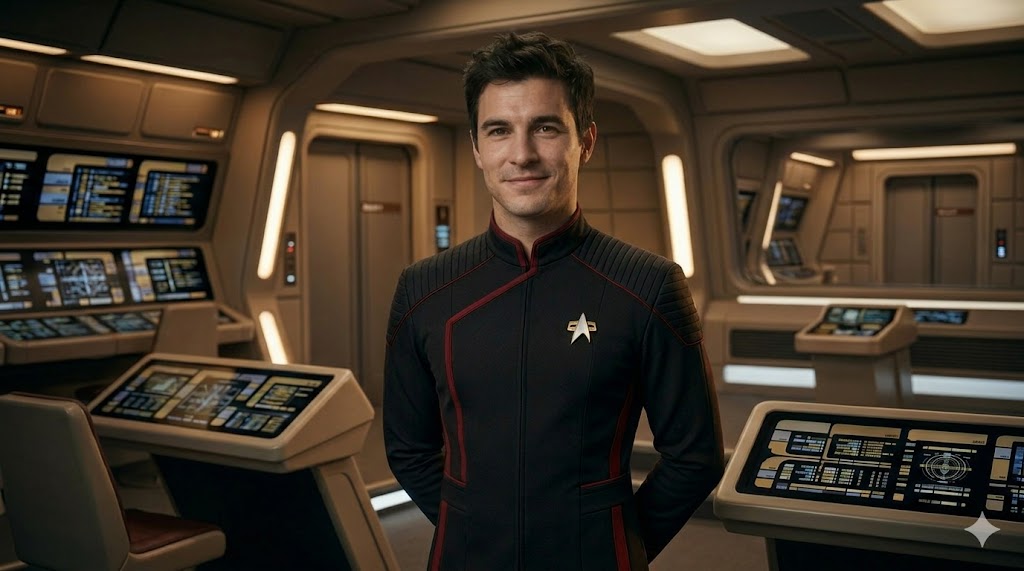
Lieutenant Callum Cowan
Name Callum Cowan
Position Chief Flight Control Officer
Rank Lieutenant
Character Information
| Gender | Male | |
| Species | Human | |
| Age | 26 |
Physical Appearance
| Height | 5'11'' | |
| Weight | 82kg | |
| Hair Color | Dark Brown | |
| Eye Color | Deep Brown | |
| Physical Description | Standing 1.80 metres (5'11") tall and weighing approximately 82 kilograms, Callum Cowan possesses the lean, athletic build of a career pilot. Dark brown hair and deep brown eyes frame a face more often found smiling than serious, lending him an approachable and easy-going presence that puts others at ease. Years spent flying rescue and evacuation missions have left him physically fit without appearing imposing, his strength built through endurance, long hours, and practical work rather than deliberate pursuit of it. He carries himself with the relaxed confidence of someone entirely at home in a cockpit, moving with an effortless sense of balance and purpose. While undeniably handsome, it is less his features that people tend to remember and more the warmth behind them; a quick smile, a ready laugh, and an openness that makes him easy company whether on duty or off. Only on rare occasions does the weight he carries show through, revealing the exhaustion and grief hidden beneath the charm and confidence that have become as much a part of him as the uniform he wears. |
Family
| Spouse | None | |
| Children | None | |
| Father | David Cowan; Emergency Response Planner; Port Perigee Local Govt | |
| Mother | Sarah Cowan; Teacher; | |
| Brother(s) | James Cowan; Deceased | |
| Sister(s) | Olivia Cowan; Jnr Infrastructure Planner; Port Perigee Local Govt | |
| Other Family |
Personality & Traits
| General Overview | At first glance, Callum Cowan is exactly what many expect from a talented young pilot: confident, sociable, quick with a joke, and possessed of just enough swagger to be occasionally insufferable. He is the sort of officer who rarely misses a social gathering, willingly embarrasses himself at karaoke, and can usually be found at the centre of a conversation rather than the edge of one. Approachable and easy-going, Cal has an instinctive ability to make people feel comfortable around him, whether through humour, genuine interest, or a willingness to laugh at himself before anyone else can. Beneath that easy charm lies a man shaped by experiences far beyond his years. During the Borg invasion, Cal served as a rescue squadron pilot, spending years flying evacuation and recovery missions under impossible conditions. The conflict forced him to grow up quickly, developing a calmness under pressure and an ability to make difficult decisions that many officers spend decades learning. While he rarely speaks about those years unprompted, they continue to influence the way he sees the world. He values people, friendships, and shared experiences deeply, having learned firsthand how quickly they can disappear. Despite his service record and numerous commendations, Cal remains quietly uncomfortable with recognition and tends to downplay his accomplishments. He is far more confident in a cockpit than in a leadership role and often feels as though he has been promoted faster than he was ever meant to be. Though trusted by those around him, he frequently questions whether he is truly ready for the responsibilities placed upon him. Importantly, Cal is not defined by grief, trauma, or loss. He laughs easily, enjoys life, pursues friendships and relationships, and embraces opportunities for adventure whenever they arise. His struggle is not learning how to be happy, but learning how to stop carrying everything alone. At his core, he remains an optimist: a man who has seen the worst the galaxy can offer and still believes there is value in exploring it. |
|
| Strengths & Weaknesses | Strengths Calm Under Pressure: Years spent flying rescue missions during the Borg invasion have given Cal an exceptional ability to remain composed during crises. While others may panic, he instinctively focuses on the next problem that needs solving and the next person who needs helping. Exceptional Pilot: An outstanding natural pilot with extensive experience in both starship and small-craft operations. Cal combines excellent instincts with disciplined training, allowing him to make difficult flying look deceptively easy. Approachable Leadership: Despite his relative youth, Cal possesses a natural ability to earn trust and build rapport with those around him. He leads through example rather than authority and is often at his best when supporting others. Adaptability: The unpredictable nature of rescue operations taught him to think quickly, improvise under pressure, and find workable solutions even when ideal options no longer exist. Optimism and Resilience: Despite everything he has experienced, Cal retains a fundamentally positive outlook on life. He genuinely enjoys people, embraces new experiences, and remains hopeful about the future. Emotional Control: Cal is remarkably difficult to rattle outwardly. He rarely allows his personal feelings to interfere with his duties and is often the steady presence others rely upon during difficult situations. Weaknesses Carries Too Much Alone: Cal has a habit of dealing with problems by himself, often refusing support he would readily offer to others. He is accustomed to being the steady hand during a crisis and struggles to admit when he is the one who needs help. Survivor's Guilt: Though rarely discussed, Cal continues to carry the weight of those he could not save. The losses of friends, fellow pilots, and loved ones during the Borg invasion have left him questioning why he survived when so many others did not. Difficulty with Vulnerability: Confident, sociable, and comfortable meeting new people, Cal finds genuine emotional vulnerability far more difficult. He has no problem opening a conversation, but opening himself is another matter entirely. Avoidance: When faced with particularly painful emotions or difficult personal conversations, Cal's instinct is often to postpone dealing with them. This tendency has contributed to strained family relationships and unresolved grief that has lingered for years. Imposter Syndrome: Despite an impressive service record and multiple commendations, Cal frequently doubts whether he truly belongs in the positions he has been given. He often feels as though he skipped steps in his career and worries that one day someone will notice. Restlessness: Years of operating under constant pressure have left Cal uncomfortable with inactivity. He prefers to stay busy and productive, often filling his time with work, hobbies, or social activities rather than sitting alone with his thoughts. |
|
| Ambitions | Like many of his generation, Cal's long-term ambitions were disrupted by the Borg invasion. Years spent focused on survival, rescue operations, and the immediate needs of others left little room for careful career planning. While he remains deeply committed to Starfleet and takes pride in serving aboard the USS Ithaca, he is still figuring out what he wants his future to look like beyond the next assignment. Professionally, Cal hopes to grow into the responsibilities he has been given and become the kind of officer younger crew members can rely upon. Though uncertain whether command is a path he ultimately wishes to pursue, he is determined to prove to himself that he belongs where he is. Personally, his ambitions are simpler but no less important. He wants to repair the fractured relationships within his family, rediscover the passions and hobbies he lost during the war, and learn how to build a life that is defined by more than survival. More than anything, Cal hopes to reach a point where he can stop looking backward and fully embrace the future he helped save. |
|
| Hobbies & Interests | Before the Borg invasion, Cal's greatest passion was historic aviation. Fascinated by the aircraft and pilots of Earth's past, he spent countless hours studying their history and recreating them in holodeck simulations. Though he remains deeply interested in the subject, the conflict left him with a complicated relationship to flying for recreation, and he continues to work toward rediscovering the joy it once brought him. Outside of duty, Cal enjoys hiking, swimming, and spending time outdoors whenever the opportunity presents itself. Having grown up on a colony world, he has always preferred real landscapes to holographic recreations, finding a sense of peace in open spaces, fresh air, and the simple act of exploring somewhere new. A naturally social individual, Cal also enjoys group activities, holodeck games, shipboard gatherings, and almost any excuse to spend time with friends. He is known for enthusiastically participating in everything from sporting competitions to karaoke nights, often with considerably more confidence than talent. He maintains a strong interest in history, particularly the history of aviation, exploration, and the people who pushed beyond the boundaries of their time. More recently, many of his interests have become tied to a quieter personal goal: reminding himself how to enjoy life again after years spent focused solely on survival. |
Service History
| Personal History | Growing up in Port Perigee Callum Cowan was born in 2359 on Port Perigee, a large Federation colony near Alpha Centauri. The eldest of three children, he grew up in a close-knit family alongside his younger brother James and youngest sister Olivia. His father, David Cowan, worked in planetary emergency planning and disaster response, while his mother, Sarah Cowan, was a local teacher known for her patience, warmth, and commitment to the community. Together they instilled in their children a strong sense of responsibility, compassion, and service to others. As the eldest sibling, Cal often found himself cast as the responsible one, though not always by choice. While James possessed an effortless charm that seemed to draw people to him and Olivia developed a talent for seeing through everyone's nonsense from an early age, Cal was usually the one expected to set an example. Despite the occasional sibling disagreements and rivalries, the three shared a close bond throughout their childhood. From an early age, Cal developed a fascination with flight. What began as childhood curiosity quickly became a lifelong passion, fuelled by Port Perigee's extensive transport infrastructure and aviation heritage. He spent countless hours around local flight facilities, learning everything he could about atmospheric and spacecraft operations, and developed a particular fascination with the history of pre-warp and early warp aviation. Long before he ever sat at the controls of a starship, he knew he wanted to fly. Though a capable student, Cal was never driven by academic prestige. He was far more interested in experiences than accolades, preferring practical learning, outdoor activities, and time spent with friends and family. By his late teens, Starfleet had become the obvious next step. It offered everything he loved: flying, exploration, adventure, and the opportunity to help people beyond the boundaries of his homeworld. The Academy Callum entered Starfleet Academy in 2377, pursuing a career in Flight Control. While he quickly established himself as a talented pilot, he was never the stereotypical top-of-the-class cadet. Cal's strengths lay less in academic competition and more in practical application, teamwork, and the ability to remain calm when situations became complicated. In simulators, flight exercises, and field training environments, he consistently excelled. Academy life suited him. He developed a wide circle of friends, participated enthusiastically in extracurricular activities, and embraced every opportunity to experience life beyond the classroom. Though he worked hard when necessary, he never lost sight of the fact that he genuinely enjoyed being there. Many who knew him during these years remember him as someone who was as likely to be found organising a social gathering as he was studying flight operations. It was during this period that his interest in historic aviation deepened into a genuine passion. Cal spent countless hours exploring holodeck recreations of Earth's aviation history, developing a particular fascination with atmospheric aircraft from the twentieth and twenty-first centuries. Friends occasionally joked that he seemed equally excited by the prospect of piloting a state-of-the-art shuttlecraft or a centuries-old propeller aircraft. By the time he graduated, Cal was regarded as a capable young officer with considerable promise as a pilot. Like many newly commissioned ensigns, he imagined a future filled with exploration, discovery, and the gradual progression of a Starfleet career. The reality awaiting his generation would prove very different. The Invasion and Recovery Callum graduated into a Starfleet very different from the one he had imagined joining. The Borg invasion transformed the Federation almost overnight, forcing Starfleet to divert enormous resources toward evacuation, humanitarian relief, and emergency rescue operations on a scale not seen in generations. Assigned to Alpha Flight of Rescue Squadron 17 aboard the rescue freighter RF Wayfarer, Cal found himself thrust almost immediately into a crisis that demanded far more of him than any newly commissioned ensign could reasonably have expected. Operating from converted freighters, transports, and emergency response vessels, the squadron was tasked with evacuating civilians, transporting refugees, delivering critical supplies, conducting search-and-rescue operations, and supporting relief efforts across multiple sectors. Though many rescue squadrons were staffed primarily by younger officers, their missions were among the most dangerous in the Federation. Cal quickly established himself as an exceptionally capable pilot, earning a reputation for calmness under pressure, creative problem-solving, and an ability to find solutions where others saw only impossible odds. His flying style often favoured unconventional approaches, but his judgement and professionalism consistently earned the trust of his squadron mates and superiors alike. During this period he formed some of the closest friendships of his life. Alpha Flight became more than a duty assignment; it became a family. The pilots, engineers, and support personnel of Rescue Squadron 17 shared hardships, losses, and triumphs that forged bonds unlike any Cal had known before. Among them was Ensign Emily-Grace Aitken, a fellow pilot whose intelligence, humour, and optimism made an immediate impression on him. As the months passed, the two grew increasingly close, finding moments of connection and normality amid a crisis that seemed determined to consume both. Although the Borg invasion itself ended relatively quickly, the humanitarian disaster it created endured for years. Rescue Squadron 17 remained heavily engaged throughout the prolonged recovery effort, conducting medical evacuations, refugee transport operations, disaster response missions, and search-and-rescue flights across a Federation struggling to rebuild. For many rescue personnel, there was no clear distinction between war and peace; there was simply another mission, another transport, another group of people who needed help. The experience came at a cost. Cal witnessed the loss of friends, colleagues, and fellow pilots with alarming regularity. The death of Emily-Grace Aitken proved particularly devastating, forcing him and the rest of Alpha Flight to continue operating while carrying grief they had little time to process. Like many survivors, he learned to compartmentalise loss in order to keep functioning. The emotional consequences of doing so would not become fully apparent until much later. By the conclusion of the recovery effort, Cal had participated in countless rescue, evacuation, and humanitarian missions, helping save thousands of lives. He accumulated an impressive service record in a remarkably short period of time and earned multiple commendations for bravery, exceptional airmanship, and civilian rescue operations. More importantly, the experience transformed him from an enthusiastic young graduate into a seasoned rescue pilot respected throughout the emergency response community. After Squadron 17 By 2383, Starfleet's large-scale recovery operations had finally begun to wind down. Rescue Squadron 17 was deactivated as the Federation gradually transitioned from emergency response to long-term reconstruction. Before dispersing to new assignments, many of the squadron's personnel spent several months on extended leave. For Cal, the period that followed proved unexpectedly important. After years spent focused entirely on survival, rescue operations, and the needs of others, he found himself relearning how to simply live. Time spent travelling with former squadron mates, reconnecting with family, and rediscovering aspects of life that had been neglected throughout the crisis became an essential part of his recovery. Though he did not realise it at the time, these experiences marked the beginning of his transition from survivor to something more balanced. Following the dissolution of Squadron 17, Cal was assigned to Starbase 30 Flight Operations Group. Serving as a Flight Leader, he supervised junior pilots and coordinated a wide variety of small-craft operations, including transport flights, courier missions, search-and-rescue standby duties, and station support activities throughout the surrounding sectors. The posting provided his first sustained leadership experience and allowed him to develop the mentoring and personnel-management skills that would later define much of his command style. It also reunited him with several former rescue personnel, allowing him to maintain many of the friendships that had become central to his life during the recovery years. Despite his professional success, the transition proved challenging in other ways. The skills that had helped him survive the invasion and recovery effort did not always translate easily to peacetime. He struggled with sleep, found it difficult to fully relax, and often felt uncomfortable with the recognition he received for his service. The numerous commendations awarded during those years remained largely hidden away in a drawer, rarely discussed and almost never displayed. Perhaps most unexpectedly, he discovered that his relationship with flying had changed. Before the invasion, aviation had been a source of curiosity, wonder, and uncomplicated joy. Afterwards, flying had become inseparable from responsibility. Though he remained fascinated by historic aircraft and flight history, he often found himself unable to enjoy them in the same carefree way he once had. The years following the crisis also saw increasing distance develop between Cal and his father. The circumstances surrounding the loss of his younger brother, James, left wounds within the family that neither man knew how to address. Rather than confront them directly, Cal focused on work, accepting new responsibilities and assignments while quietly avoiding conversations he was not yet ready to have. By the time he received orders to report to the USS Ithaca in 2385, Callum Cowan was regarded as one of Starfleet's most promising young pilots. Beneath the confidence, humour, and easy-going personality that others saw, however, remained a man still learning what life looked like when survival was no longer the primary objective. In many ways, his assignment to the Ithaca marked the beginning of that journey. |
|
| Service Record | 2377–2381 Cadet, Starfleet Academy Flight Control Track Entered Starfleet Academy with a focus on Flight Control and small-craft operations. Demonstrated strong practical aptitude in flight simulators, atmospheric operations, and emergency response exercises. Graduated in 2381. 2381 Starfleet Flight Operations Commissioned shortly before the escalation of the Borg invasion. Initial assignment was interrupted by the rapidly expanding humanitarian crisis, resulting in reassignment to emergency rescue operations. 2381–2383 RF Wayfarer - Alpha Flight, Rescue Squadron 17 Rescue Squadron Pilot Federation Emergency Response & Evacuation Operations Assigned to one of Starfleet's rescue squadrons operating from converted logistics and transport vessels during the Borg invasion and subsequent recovery effort. Flew evacuation, search-and-rescue, refugee transport, medical transfer, and humanitarian support missions across multiple operational theatres. Accumulated extensive flight experience in shuttlecraft, runabouts, and auxiliary craft under hazardous conditions. Earned multiple commendations for courage, exceptional airmanship, and civilian rescue operations. Developed a reputation for calmness under pressure, innovative problem-solving, and reliability during complex evacuation missions. Served alongside numerous civilian relief organisations, Starfleet support units, and Federation emergency response agencies throughout the invasion and the prolonged humanitarian recovery that followed. 2383–2385 Starbase 30 Flight Operations Group Flight Leader Following the winding down of Federation-wide emergency relief operations and the deactivation of Rescue Squadron 17, reassigned to Starbase 30 Flight Operations Group under the command structure of former Squadron 17 personnel. Served as a Flight Leader responsible for the supervision, training, and operational readiness of small-craft crews supporting transport, search-and-rescue, courier, and station support operations throughout the surrounding sectors. This assignment marked Cowan's first sustained leadership posting and provided experience in personnel management, flight coordination, and mentoring junior pilots. During this period he earned promotion to Lieutenant and was recognised for his professionalism, instructional aptitude, and ability to operate effectively in both routine and emergency environments. 2385- Chief Flight Control Officer, USS Ithaca Selected for assignment to the USS Ithaca following a distinguished record in rescue operations and small-craft leadership. Chosen due to extensive operational flight experience, demonstrated leadership potential, and an exceptional service record during the Borg invasion and subsequent recovery effort. Current responsibilities include navigation, flight operations, helm control, small-craft coordination, and supervision of the vessel's Flight Control personnel. |
|
| Awards & Medals | Starfleet Medal of Commendation Awarded for sustained excellence in humanitarian and rescue operations during the Borg invasion. Starfleet Medal for Valor Awarded following a high-risk evacuation mission in which Cowan successfully extracted civilians from an active crisis zone despite severe navigational hazards and damage to his craft. Starfleet Humanitarian Service Award Recognising distinguished service in large-scale refugee evacuation and civilian relief operations. Citation for Conspicuous Gallantry (x2) Awarded for acts of courage and exceptional professionalism during emergency rescue missions conducted under extreme operational conditions. Meritorious Service Citation (x3) Awarded for exemplary performance, leadership, and dedication during prolonged rescue squadron deployments. Search and Rescue Qualification Device Recognising extensive operational experience in rescue, recovery, and humanitarian flight operations. |
|
| Reprimands & Disciplinary Actions |